
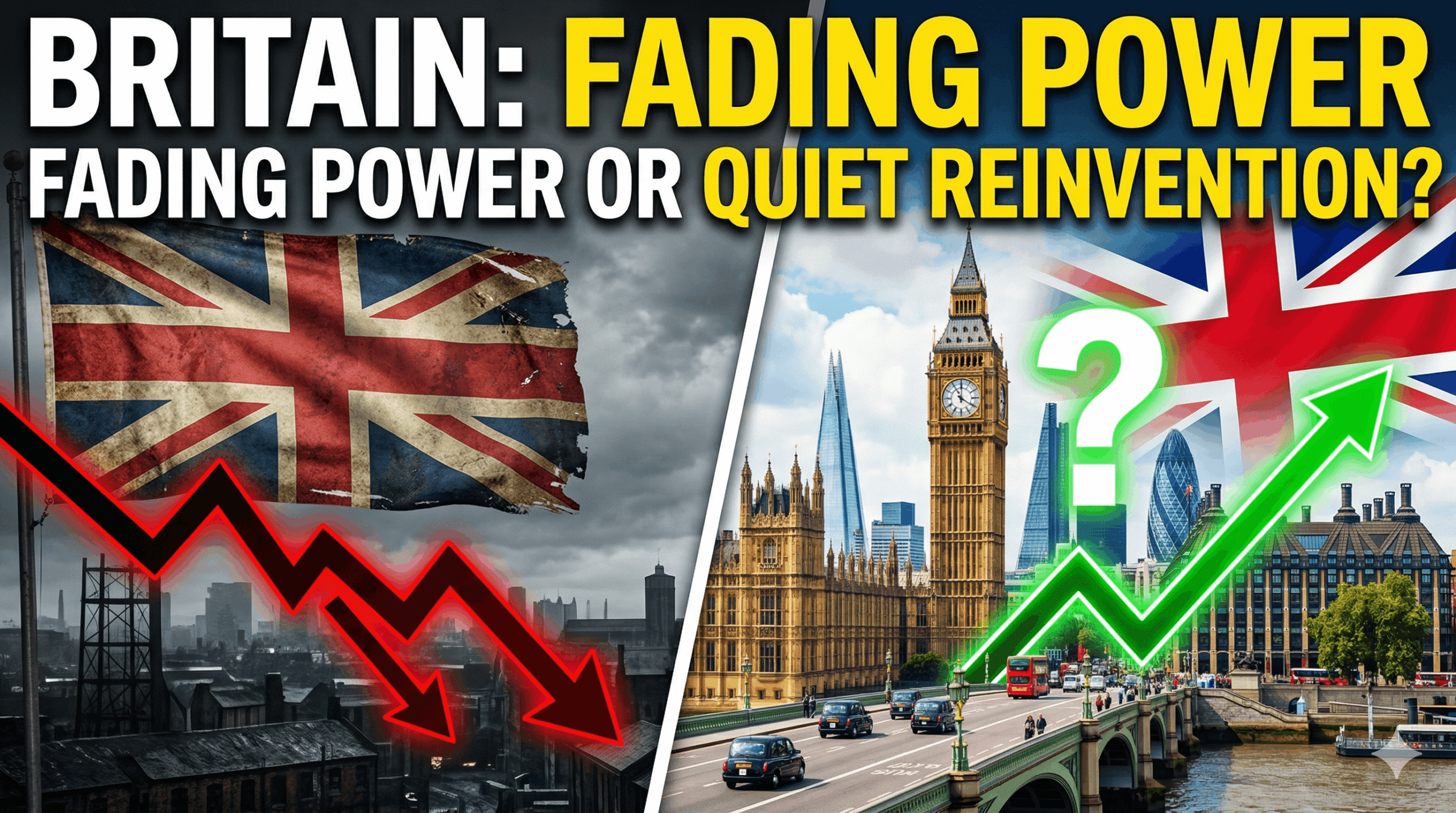
The UK still holds real global assets — but the gap between its ambitions and its means is growing harder to ignore.
For much of the post war era, UK managed a remarkable trick — acting like a great power on a middle power’s budget. A permanent UN Security Council seat, a nuclear deterrent, the English language, and a web of alliances gave it influence that far exceeded its economic size. That trick is becoming harder to pull off.
Brexit’s cost to British influence
Leaving the EU was sold as liberation — a “Global Britain” free to engage the world on its own terms. Instead, it removed the UK from one of the most powerful diplomatic blocs on earth. On trade, sanctions, climate, and regulation, Britain now negotiates alone where it once spoke for 500 million people. The bilateral deals signed since have been welcome but modest in impact, and the promised transformational partnerships have mostly not materialised.
Military ambition, constrained budgets
Britain’s support for Ukraine has demonstrated that it can still lead when it chooses to. But the effort has also exposed how thin the margins are — strained stockpiles, capability gaps, and a defence budget that struggles to cover both modernisation and current commitments. The aircraft carriers are real; so are the limits on what can be sustained behind them.
“The question is no longer whether Britain matters — it is how, and where, it chooses to matter.”
What Britain still has
Decline is not the whole story. The City of London remains a pillar of global finance. British universities, the BBC World Service, and an unrivalled cultural output give the UK soft power that most nations can only envy. The Commonwealth, often underused, offers a network spanning 56 countries across every continent. And alliances like AUKUS and Five Eyes keep Britain embedded in the most consequential security architecture in the world.
A world that has moved on
The deeper challenge is structural. China, India, and the broader Global South are reshaping the rules of international order — and they are doing so with less deference to Western-led institutions than previous generations showed. In this more contested, multipolar world, Britain’s historical advantages carry less automatic weight than they once did.
The path forward
Britain is not in freefall. But it faces a genuine choice: continue reaching for a global role its resources cannot fully sustain, or focus its considerable remaining assets — diplomatic skill, financial clout, intelligence capability, cultural reach — more sharply and strategically. Relevance in the 21st century will belong to nations that know what they are for, not simply what they once were.









Leave a Reply