
🌍 Introduction: Why April 12 Still Shapes the Future of Humanity
Every year, April 12 stands as one of the most powerful reminders of what humanity can achieve when ambition meets scientific innovation. Known as Cosmonautics Day, this occasion commemorates the historic moment when Yuri Gagarin became the first human being to leave Earth and journey into outer space. His mission was not just a technological breakthrough—it was a psychological and cultural turning point that reshaped how humans viewed their place in the universe.
The importance of this day goes far beyond a single nation. While it is deeply rooted in the history of Russia and the former Soviet Union, Cosmonautics Day represents a collective human victory. It symbolizes the beginning of a new era where Earth was no longer the boundary of human exploration. In today’s context—marked by private space companies, interplanetary ambitions, and global collaboration—this day continues to inspire innovation, education, and international unity.
🌌 What is Cosmonautics Day?
Cosmonautics Day is celebrated every year on April 12 to honor the historic achievement of Yuri Gagarin, who became the first human to travel into outer space in 1961. This day marks a defining moment not only in Soviet history but in the entire journey of humanity toward space exploration.
The celebration originated in the Soviet Union and later gained global recognition as the International Day of Human Space Flight. It symbolizes technological advancement, courage, and the limitless potential of human ambition.
📌 Key Facts:
- Celebrated primarily in Russia
- Recognized globally by the United Nations
- Marks the beginning of human space exploration
- Symbolizes scientific achievement and human ambition
This day is not just about remembering the past — it’s about celebrating the limitless future of humanity in space.
👨🚀 Yuri Gagarin: The First Human in Space
Yuri Gagarin was a Soviet Air Force pilot selected for a top-secret space mission during the height of the Cold War. On April 12, 1961, he boarded the spacecraft Vostok 1 and completed a full orbit around Earth.
- Mission duration: 108 minutes
- Orbit: 1 complete revolution around Earth
- Famous phrase: “Poyekhali!” (Let’s go!)
His successful journey proved that humans could survive and function in space, opening the door for future space exploration missions.
🛰️ The Historic Breakthrough: Gagarin’s Flight and Its Global Shockwave
On April 12, 1961, the Soviet Union achieved what many had thought impossible. Yuri Gagarin was launched into orbit aboard the spacecraft Vostok 1, completing a full revolution around Earth in approximately 108 minutes. This mission demonstrated that humans could survive and function in the harsh conditions of space, effectively opening the gateway for all future space exploration.
The mission itself was meticulously planned but still carried immense risk. Scientists had limited understanding of how the human body would react to zero gravity, radiation exposure, and the psychological stress of isolation in space. Gagarin’s calm demeanor and successful return not only validated years of scientific research but also provided confidence for more complex missions in the future. His famous exclamation, “Poyekhali!”—meaning “Let’s go!”—became a symbol of courage and the spirit of exploration.
The global reaction was immediate and profound. Nations across the world recognized that a new technological era had begun. The achievement triggered both admiration and urgency, particularly in the United States, where it intensified efforts to accelerate their own space program. This single mission effectively transformed space exploration from a theoretical pursuit into a tangible reality.

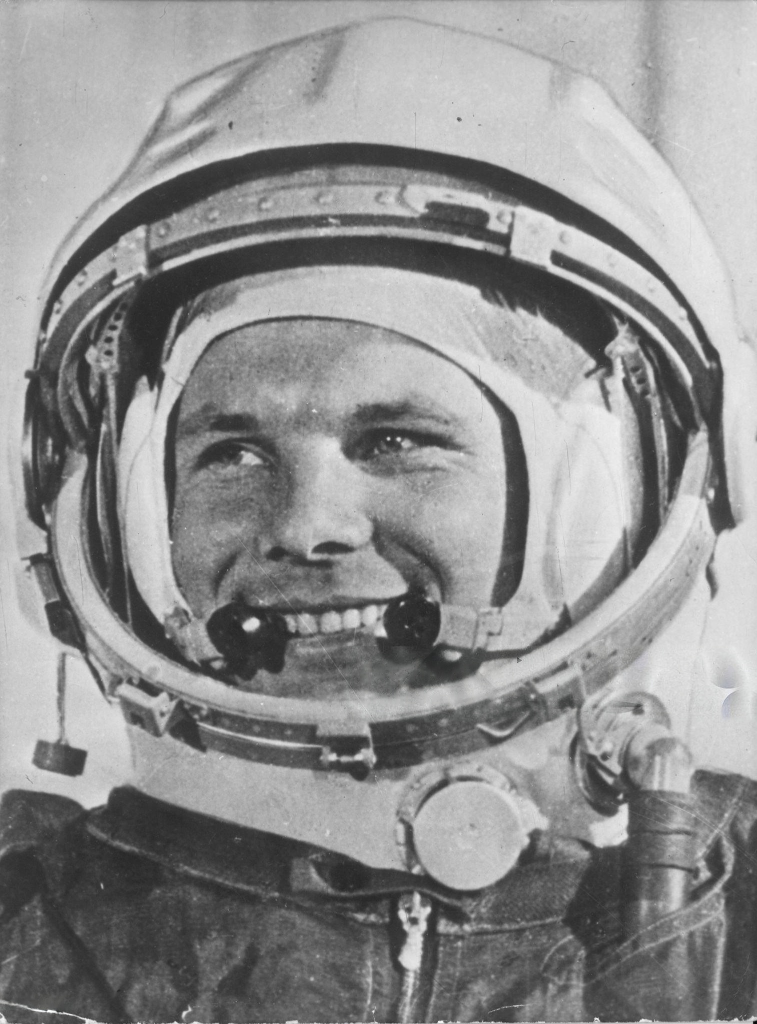
Soviet cosmonaut Yuri Gagarin wearing his helmet for the first ever manned flight in space.
⏳ Timeline of the Space Race
🚀 Key Events Leading to Gagarin’s Flight
- 1957 – Sputnik 1 launched by the Soviet Union
- 1959 – Luna missions reach the Moon
- 1960 – First human spaceflight trials begin
🌍 The Historic Breakthrough
- April 12, 1961 – Yuri Gagarin completes first human spaceflight via Vostok 1
🛰️ Aftermath & Escalation
- 1962 – John F. Kennedy announces Moon mission goal
- 1969 – Apollo 11 Moon Landing by the USA
🌍 Why April 12 Changed Human History
April 12, 1961, was not just a Soviet victory—it was a turning point for humanity. For the first time, humans broke free from Earth’s gravitational boundaries and entered space.
This achievement:
- Proved human survival in space
- Accelerated scientific innovation
- Inspired generations worldwide
It marked the beginning of a new era where space became the next frontier of exploration.
🧠 The Cold War Context: Space as a Battlefield of Ideologies
To fully understand the significance of Cosmonautics Day, it is essential to examine the geopolitical environment in which it occurred. The early 1960s were defined by the Cold War—a period of intense rivalry between the Soviet Union and the United States. This competition extended beyond military power into science, technology, and ideological influence, with space becoming the ultimate arena for demonstrating superiority.
The Soviet Union had already gained an early advantage with the launch of Sputnik 1 in 1957, the world’s first artificial satellite. This event shocked the global community and marked the beginning of the space race. Gagarin’s successful flight further solidified Soviet dominance in the early stages of this competition, showcasing their advanced rocket technology and scientific capabilities.
For the United States, this was a wake-up call. It led to increased funding for NASA, the eventual Apollo missions, and the historic Moon landing in 1969. However, beyond competition, the space race also accelerated technological progress at an unprecedented rate. Innovations developed during this period laid the foundation for modern computing, telecommunications, and satellite systems that continue to shape our daily lives.
🎉 Cosmonautics Day: National Pride and Global Recognition
In Russia, Cosmonautics Day is not just a historical observance—it is a deeply emotional and patriotic celebration. Established in 1962, just one year after Gagarin’s flight, the day serves as a tribute to the courage of cosmonauts and the brilliance of Soviet-era scientists and engineers.
Over time, the significance of April 12 expanded beyond national borders. In 2011, the United Nations officially recognized it as the International Day of Human Space Flight, emphasizing its importance as a milestone for all humanity. This global recognition reflects the universal impact of Gagarin’s achievement, transcending political boundaries and uniting people under a shared sense of wonder and possibility.
The day is marked by a wide range of activities, from official ceremonies and educational programs to public events and media coverage. It serves as both a remembrance of the past and a celebration of the future, encouraging new generations to pursue careers in science, technology, engineering, and mathematics.
🇷🇺 Celebrations in Russia: Honoring Heroes and Inspiring Generations
Celebrations of Cosmonautics Day in Russia are characterized by a blend of solemn remembrance and enthusiastic public engagement. Major cities host parades, exhibitions, and cultural events that highlight the achievements of the Soviet and Russian space programs.
One of the most significant aspects of the celebration is the tribute paid to Yuri Gagarin and other cosmonauts. Monuments dedicated to Gagarin become focal points for ceremonies where officials and citizens lay wreaths and reflect on his legacy. Educational institutions organize lectures, competitions, and science fairs to engage students and foster interest in space exploration.
Museums and space centers play a crucial role during this time, offering interactive exhibits and historical displays that bring the story of human spaceflight to life. These events not only preserve the memory of past achievements but also inspire future innovators who may one day contribute to humanity’s journey beyond Earth.
🌐 Yuri’s Night: A Global Celebration of Space Culture
While Cosmonautics Day has its origins in Russia, its influence has spread worldwide through events like Yuri’s Night. Celebrated on April 12 across multiple countries, Yuri’s Night combines science, culture, and entertainment to create a unique global festival dedicated to space exploration.
These celebrations often include public lectures by scientists and astronauts, stargazing events, film screenings, and themed parties. The goal is to make space science accessible and exciting for people of all ages, bridging the gap between complex scientific concepts and everyday curiosity.
Yuri’s Night reflects the universal appeal of space exploration. It demonstrates that the legacy of Yuri Gagarin is not confined to one nation but belongs to the entire world. By bringing together diverse communities, it fosters a sense of global unity and shared aspiration.
👨🚀 Yuri Gagarin: The Man Behind the Mission
Understanding Cosmonautics Day requires a closer look at the life of Yuri Gagarin himself. Born in 1934 in a small village, Gagarin came from humble beginnings. His early life was shaped by the hardships of World War II, but he displayed a strong interest in aviation from a young age.
After training as a pilot, he was selected for the Soviet space program due to his exceptional skills, physical fitness, and psychological resilience. His selection was not just about technical ability—it was also about representing the ideals of the Soviet Union to the world.
Gagarin’s journey to space transformed him into an international icon overnight. He traveled extensively, meeting world leaders and inspiring millions. Despite his fame, he remained grounded and committed to his work. His legacy continues to influence astronauts, scientists, and dreamers around the globe.
🚀 The Lasting Impact on Space Exploration and Technology
The success of Vostok 1 had far-reaching consequences that continue to shape the modern world. It paved the way for a series of advancements in space exploration, including longer missions, spacewalks, and the development of space stations.
Technological innovations born out of the space race have had a profound impact on everyday life. Satellite communication enables global connectivity, GPS systems guide navigation, and Earth observation satellites contribute to weather forecasting and disaster management. These advancements highlight how space exploration extends its benefits far beyond the confines of scientific research.
In recent years, the space industry has entered a new phase characterized by private sector involvement and international collaboration. Missions to Mars, plans for lunar bases, and the rise of space tourism all trace their origins back to the pioneering efforts of early missions like Gagarin’s.
🇮🇳 India’s Perspective: Inspiration and Collaboration
India’s journey in space exploration has been significantly influenced by early achievements like Gagarin’s flight. The establishment of the Indian Space Research Organisation marked the beginning of a new chapter in the country’s scientific development.
India has collaborated with Russia on several space initiatives, benefiting from shared expertise and technological exchange. Today, India is preparing for its own human spaceflight mission, reflecting the enduring inspiration drawn from pioneers like Gagarin.
Cosmonautics Day serves as a reminder for countries like India that space exploration is not limited to superpowers. It reinforces the idea that with determination and innovation, any nation can contribute to humanity’s quest to explore the cosmos.
🔮 The Future of Space Exploration: Carrying Forward the Legacy
As we look toward the future, the spirit of Cosmonautics Day remains more relevant than ever. The space industry is undergoing rapid transformation, driven by advancements in artificial intelligence, reusable rockets, and international partnerships.
Ambitious projects such as missions to Mars, lunar colonization, and deep-space exploration are no longer distant dreams. They represent the next phase of human evolution as a spacefaring species. The foundation for these endeavors was laid on April 12, 1961, when Yuri Gagarin proved that space was within reach.
The challenges ahead are significant, ranging from technical complexities to ethical considerations. However, the lessons of the past—courage, innovation, and collaboration—provide a roadmap for overcoming these obstacles.
🏁 Conclusion: A Celebration of Human Potential
Cosmonautics Day is more than a historical milestone—it is a celebration of human potential and the relentless pursuit of knowledge. The journey of Yuri Gagarin aboard Vostok 1 marked the beginning of an era that continues to inspire generations.
In a world often divided by politics and ideology, space exploration serves as a unifying force. It reminds us that beyond our differences, we share a common curiosity about the universe and a collective desire to explore it. As humanity continues to push the boundaries of what is possible, the legacy of Cosmonautics Day will remain a guiding light for future generations.
Cosmonautics Day is celebrated on April 12 to honor the first human spaceflight by Yuri Gagarin, marking the beginning of human space exploration.
He demonstrated that humans could travel to space and return safely, opening the door for all future missions.
The United Nations declared it the International Day of Human Space Flight to acknowledge its global significance.
It encourages innovation, education, and international cooperation in space exploration.
India has collaborated with Russia in space missions and continues to draw inspiration from early Soviet achievements. 1. What is Cosmonautics Day and why is it important?
2. How did Yuri Gagarin change history?
3. Why is April 12 recognized internationally?
4. How does Cosmonautics Day inspire modern science?
5. What is the connection between Russia and India in space?














Leave a Reply