
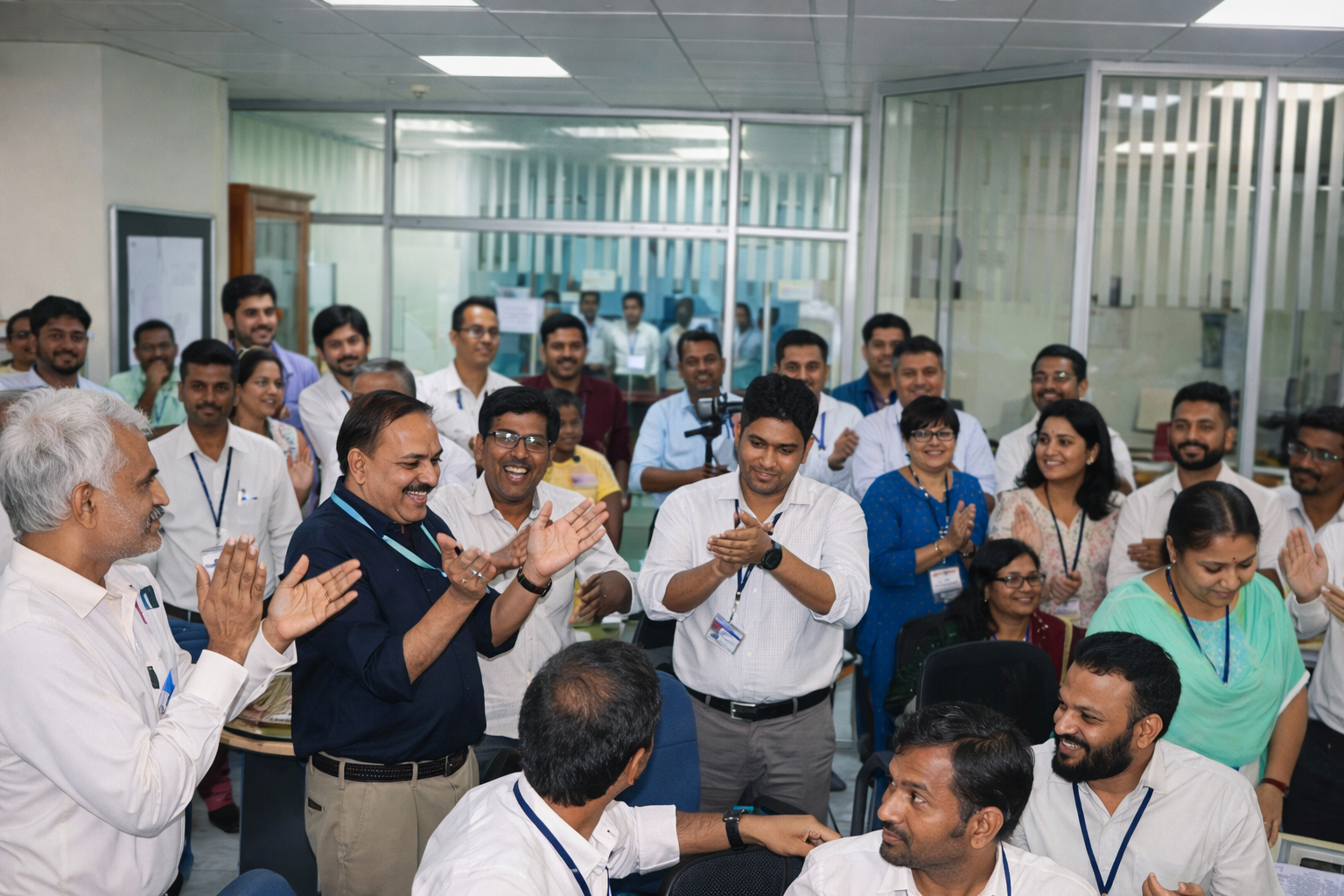
PFBR Reaches Criticality – A Historic Nuclear Milestone
On 6 April 2026 India’s indigenously built Prototype Fast Breeder Reactor (PFBR) at Kalpakkam (500 MWe) “successfully attained first criticality”. This controlled start of fission marked a “defining step” advancing India into the second stage of its three-stage nuclear programme. Prime Minister Modi hailed it as proof of India’s scientific strength and a bridge to harness its vast thorium reserves. (Only Russia currently has a commercial breeder; India will be the second country.) The DAE press release stresses long-term energy security and using more energy from limited uranium while preparing for large-scale thorium use. It also cites advanced safety systems, liquid sodium coolant, and a closed fuel cycle approach to improve sustainability.
Three-Stage Nuclear Program: From URANIUM
India’s programme (conceived by Homi Bhabha) progressively multiplies fuel by using each stage’s spent fuel in the next. The stages are:
- Stage 1 (PHWR): Uses natural uranium in heavy-water reactors. Spent fuel yields plutonium (Pu-239).
- Stage 2 (FBR): Pu from Stage 1 is mixed with uranium to make MOX fuel for fast breeders. The PFBR has a U-238 blanket around its core. Fast neutrons convert U‑238 to Pu-239, “breeding” more fuel than it consumes. PFBR is a “bridge” reactor: it will eventually use Th-232 in the blanket and transmute it to U-233.
- Stage 3 (Th Reactors): Uses U-233 (bred in Stage 2) in advanced thermal reactors using thorium. This leverages India’s ~25% of world thorium reserves (India has ~846,000 t vs world ~6.35 Mt). Thorium (Th-232) is fertile and becomes fissile U-233 after neutron irradiation. Using thorium means an abundant, low-carbon fuel for the long term.
Each stage closes the fuel cycle: spent fuel is reprocessed and recycled rather than dumped. For example, PFBR uses plutonium recovered from used PHWR fuel, and its spent MOX fuel will be reprocessed. This makes fuel use highly efficient and reduces long-lived waste.
Why Breeder Reactors? Fuel Efficiency and Energy Security
Fast breeders like the PFBR can exploit all components of uranium and thorium. Conventional reactors use only the ~1% fissile U-235 in natural uranium and leave much fertile U-238 unused. In contrast, PFBR’s design “produces more fuel than it consumes”. It converts U-238 (in blanket) into Pu-239, and later Th-232 into U-233. DAE highlights this as enabling India to “extract far greater energy from its limited uranium reserves” while gearing up for thorium power.
Advantages: The PFBR’s fast neutrons and MOX fuel (U+Pu oxides) boost fuel utilization. It also burns some nuclear waste: plutonium from Stage 1 and U-235 fissile material get consumed, reducing the volume of high-level waste. In theory, breeders can make a country essentially self-sufficient in fuel by fully exploiting its uranium and thorium stocks. India’s thorium-rich coast (see map) offers a potentially vast energy source if bred into U-233.
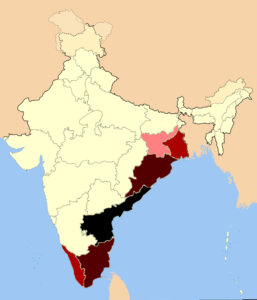
Map of India’s thorium deposits (Andhra Pradesh 31%, Tamil Nadu 21%, Odisha 20%, Kerala 16%, West Bengal 10%, Jharkhand 2%). India holds a very large share of global thorium (25%+), which PFBR-stage reactors aim to exploit.
Current Energy Needs: Nuclear power today provides only ~3% of India’s electricity. The PFBR breakthrough is aimed at dramatically expanding that share. India plans to raise nuclear capacity to ~100 GW by 2047. Long-term, a successful breeder/Thorium path could secure centuries of fuel for India’s power needs.
Global Context: Other Breeder Programs
In the 1970s–80s, many countries launched fast-breeder R&D (US, France, UK, Japan, Soviet Union). But most gave up. High costs, technical hiccups and public fears stalled projects:
- USA: The Clinch River Breeder (1970s-80s) was canceled amid rising costs and changing energy policies.
- Japan: The Monju FBR (280 MWe) suffered leaks and accidents (a 1995 sodium fire), operated only briefly, and was finally scrapped in 2016. Japan spent billions but eventually chose to decommission Monju.
- France: The large Superphénix FBR (1,240 MWe) ran in the 1980s-90s but was closed in 1997 due to cost and protests.
- Russia: Russia is the exception: it operates the 600 MWe BN-600 and 880 MWe BN-800 breeders (at Beloyarsk) with some success. Russia remains the only country with a commercial-scale breeder so far.
By contrast, India persisted. As ex-AEC chair Anil Kakodkar noted, “when many countries in the world were abandoning this technology, India believed in its potential”. India treats breeders as a strategic necessity for fuel security rather than just an economic choice. If PFBR leads to successful breeder deployment and Thorium reactors, India would join “a few nations reshaping the future of nuclear energy.”.
PFBR Technical Highlights
- Reactor design: PFBR is a pool-type sodium-cooled fast reactor. It uses liquid sodium coolant (at ~550 °C) because sodium transmits heat well and doesn’t slow down fast neutrons. The PFBR core fuel (U-Pu MOX) is surrounded by a blanket of U-238 (and later Th-232) to capture neutrons.
- Fuel cycle: PFBR follows a closed fuel cycle. After its fuel burns, the spent MOX can be reprocessed to recover Pu and U for reuse. This reduces waste and maximizes resource use.
- Safety systems: The PFBR incorporates advanced safety measures. For example, the DAE notes “inherent passive safety” features and multiple backup systems. It operates at low pressure (sodium boils at ~882 °C, vs water at 100–300 atm), reducing the risk of explosive pressure release.
- Scale and timeline: Construction began in 2004 (originally due ~2010). Fuel loading started Mar 2024, and criticality was reached in Apr 2026. Commercial operation is pending further tests. The DAE sees this as validation of India’s indigenous reactor design and engineering.
Challenges and Safety Concerns
Fast breeders have inherent technical and cost challenges:
- Sodium coolant risks: Liquid sodium reacts violently with water and air. Any sodium-water leak (e.g. in steam generators) can cause fire or explosions. Past breeders (Monju, BN-350, etc.) saw numerous sodium leaks and fires. The PFBR’s secondary systems are designed to minimize leaks, but sodium handling adds complexity. In case of a leak, sodium must be carefully cleared to avoid chain reactions.
- Radioactivity: Sodium becomes highly radioactive (Na-24) when exposed to neutrons. PFBR uses intermediate loops of non-radioactive sodium and added heat exchangers to isolate the radioactive primary loop, but this increases system complexity and cost.
- Reliability and maintenance: Historical data show many sodium-cooled reactors spent more time offline (for maintenance/repair) than generating power. Refueling/repair requires draining and flushing sodium, which is time-consuming and costly. India will need sustained engineering effort to keep PFBR reliable.
- Economic cost: Fast reactors are very capital-intensive. Reviews note breeder capital costs are typically 2–3× those of standard reactors. The PFBR project has been decades-long: initial cost estimates roughly doubled or more. Independent analysts (UBC’s Ramana) point out that PFBR’s electricity cost could exceed that of heavy-water reactors by 80% or more, and be more expensive than renewables. This reflects large up-front investment in first-of-a-kind tech.
- Fuel reprocessing: Breeders rely on reprocessing (to extract Pu and U-233). Reprocessing facilities are complex and raise proliferation/security concerns. India already operates reprocessing for PHWR fuel, but scaling it safely is non-trivial.
Despite these challenges, India’s experts argue the payoff will be cleaner, self-reliant power. The DAE emphasizes that fast breeder technology strengthens fuel-cycle capabilities and will support “next-generation nuclear technologies”. Former AEC chair Kakodkar and others stress that PFBR’s success validates decades of R&D and opens the path for thorium reactors.
Implications for Energy Independence
If fully realized, the breeder/Thorium programme could transform India’s energy future. India’s uranium is scarce, but its thorium is abundant. By breeding U-233 from Th, India could secure fuel “for centuries,” as analysts note. Nuclear power would then rely much less on imported uranium or fossil fuels.
This fits into India’s clean energy goals. Nuclear (3% of generation now) is targeted to expand (to ~22 GW by 2032 and 100 GW by 2047). PFBR criticality came just before India’s pledge of net-zero by 2070; officials link nuclear expansion to that goal. In summary: achieving PFBR criticality is a “big leap toward energy independence”, giving India a strategic, self-sufficient route to low-carbon power.
Sources: Official DAE/IGCAR releases, press reports and analysis, and technical reviews. These collectively detail the PFBR milestone, its role in India’s three-stage programme, and the technical, safety and economic context of fast breeder reactors.









Leave a Reply