
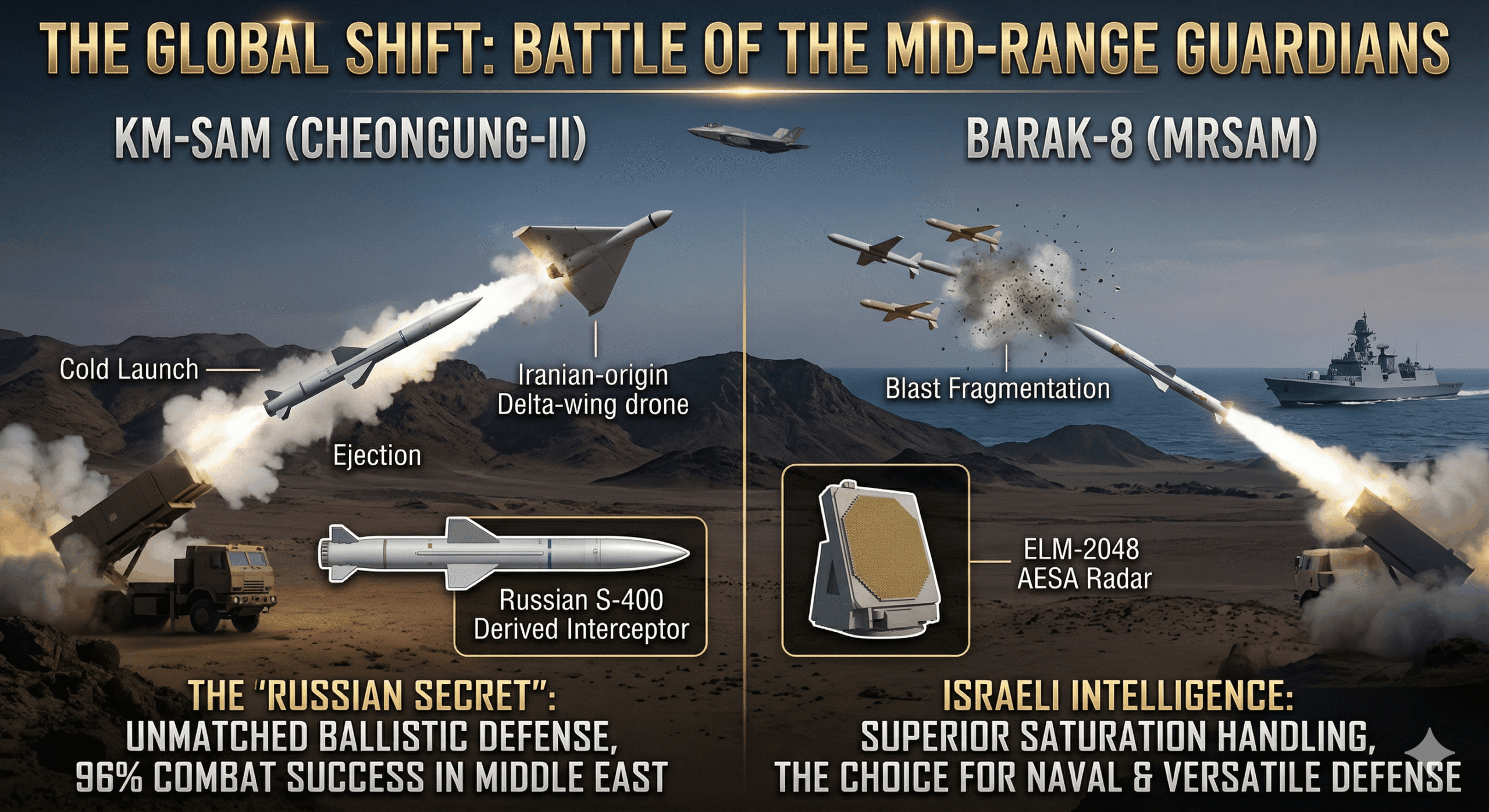
In the high-stakes theater of Middle Eastern geopolitics, a new name has emerged to challenge the dominance of American and Israeli air defense systems. In early 2026, during a series of complex aerial salvos involving dozens of drones and ballistic missiles, the KM-SAM (Cheongung-II) reportedly achieved a staggering 96% success rate.
While the world watches South Korea’s rise as a global arms exporter, a deeper look reveals a surprising technological lineage: the “Korean Patriot” is actually built on a foundation of elite Russian engineering.
The Russian DNA: An Unlikely Alliance
The KM-SAM is not a purely indigenous Korean invention. Its origin story dates back to the 1990s and a unique technology transfer deal with Russia. Faced with maturing debts, Moscow provided South Korea with advanced missile blueprints and radar technology from the Almaz-Antey design bureau.
Technically, the KM-SAM shares the same “DNA” as the Russian S-350 Vityaz and the legendary S-400 Triumf.
The Interceptor: The KM-SAM’s missile is a direct derivative of the Russian 9M96 series.
The Launch Method: It utilizes the “Cold Launch” technique—where the missile is ejected from its tube before the engine ignites—a signature feature of Russian high-tier systems that allows for rapid 360-degree engagement.
Performance Under Fire: UAE and Saudi Arabia
Recent operational data from the United Arab Emirates has sent shockwaves through the defense community. In March 2026, during a sustained “swarm” attack, the KM-SAM batteries deployed in the UAE engaged approximately 30 targets, successfully neutralising 29 of them.
This performance is particularly notable because it outperformed Western counterparts in terms of cost-to-kill ratio. For countries like Saudi Arabia, which recently signed a $3.2 billion deal for the system, the KM-SAM offers a middle ground: it provides Russian-style power and “Hit-to-Kill” precision without the political baggage of buying directly from Moscow.
Head-to-Head: KM-SAM vs. Barak-8
For observers in the Indo-Pacific, the most relevant comparison is with the Indo-Israeli Barak-8 (MRSAM). While both are medium-range systems, they represent two different philosophies of warfare:
| Feature | KM-SAM (South Korea/Russia) | Barak-8 (India/Israel) |
| Philosophy | “Russian Power” – Focuses on raw kinetic speed and high-G maneuverability. | “Israeli Intelligence” – Focuses on advanced radar tracking and saturation handling. |
| Kill Mechanism | Hit-to-Kill: Direct physical impact to destroy the target warhead. | Proximity Fuse: Explodes near the target to shred it with a fragment cloud. |
| Radar | Multi-function PESA (heritage from S-400). | ELM-2048 AESA (widely considered the world’s best for small drones). |
The “Global Shift” Perspective
The success of the KM-SAM represents a significant shift in the global arms market. It proves that the “South Korean Model”—combining foreign foundational technology with superior domestic manufacturing and electronics—is a winning formula.
As the S-400 technology continues to protect the skies of the Gulf through its Korean cousin, the line between Western-aligned hardware and Eastern-engineered physics continues to blur. For defense analysts, the message is clear: the next era of air defense will be defined not by who built the first prototype, but by who can perfect the integration.
Key Takeaways for “The Global Shift” Viewers:
The 96% Figure: This isn’t just marketing; combat data from the 2026 Middle East escalations backs it up.
The Russian Link: South Korea has successfully “Westernized” Russian missile brilliance.
Economic Impact: With lower maintenance costs than the US Patriot, the KM-SAM is becoming the “Goldilocks” choice for regional powers.













Leave a Reply